


Brewing in Görlitz and the Role of Obermarkt 4 as a Brewhouse
Our House and Beer
Click on a topic to learn more about the city’s historical developments, architectural features, and key events.
The Development
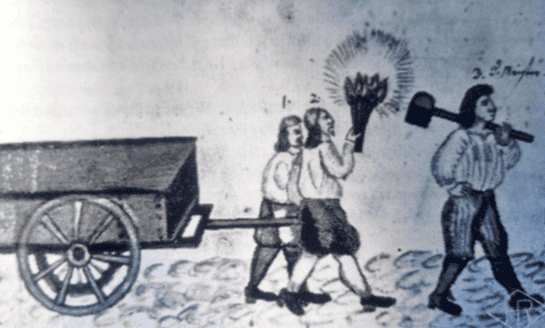
Görlitzer Braupfanne um 1710 aus Richard Jecht, Geschichte der Stadt Görlitz, 1927-1934, 1. Band, 2. Halbband, S. 502
Brewing process and privileges
Each year, the city council assigned a brewing quota through a lottery system. This also determined the order in which the brewmasters could brew and serve their beer.
- wheat beer (in winter)
- barley beer (in summer)
- Märzen (a spring beer made from barley that had to be consumed quickly)
- “Tränkenbier” – a quickly brewed beer meant for immediate consumption (half barley, half wheat)
- Brewmasters purchased grain and had it delivered to their property.
- Household workers soaked the grain with malt water.
- A sworn maltster took over the soaked grain.
- The dried malt was handed over to the household staff to be brought to the mill in sacks.
- It was then ground under supervision of two sworn citizens and the sworn miller.
- The household servant brought the ground malt back to the brewhouse, where the brewer made the beer.
- A washerwoman filled the beer into barrels.
- Wheat beer was ready to serve after two to three weeks, while barley beer could be served after eight days.
The Hall House as a Brewhouse
Typical features of Görlitz “hall houses” include:
- a central hall spanning several floors, often vaulted
- staggered floors throughout the building
Similar architectural types can be found in northern Italy.
The brewing area was typically located at the rear of the house and needed to accommodate large brewing kettles. Some of the first-floor rooms may have also been used for serving beer in the 15th and 16th centuries.
At Obermarkt 4, the central hall was later converted into the staircase during major renovations in the mid-19th century.
Conflicts and Competition
Görlitz beer did not have a reputation for export quality. Many residents, for reasons of cost and possibly also taste, preferred other beers – one popular alternative was beer from Muskau.
This created conflicts with nobles who had brewing rights for their own consumption and with taverns outside the city (known as “Kretschamen”) that didn’t serve Görlitz beer.
As a result, at times only 60% of the licensed beer in Görlitz was actually brewed and sold, which reduced the city’s expected tax revenue.
In 1618, a legal dispute began between Görlitz and local noble estates (notably Königshain and Kunnersdorf) that dragged on until 1744.
Guests and Staff
Taverns and brewhouses were not exclusively male spaces. Much like today, couples often went out together to drink.
Guests included farmers from the surrounding area and travelers.
Brewing operations often employed women as well – such as washerwomen who filled barrels and “beer servers” who were responsible for tasting and improving the beer, judging its strength and yeast quality, and ensuring proper temperature.
Beer servers were strictly forbidden from consuming alcohol themselves.
Beer Service
Beer was served in order of rotation among brewhouses.
In the 17th century, a brewhouse in turn would hang a wreath of green branches over a painted wooden sign to indicate it was serving beer. The sign often showed a table scene with guests.
In some cases, the signal was simpler – just a branch of greenery, a bench outside the door, or a lit fire basket in the evening.
By the end of the 16th century, different types of beer were marked with colored cones: red for old beer, green for Märzen or lager beer. In the 17th century, white cones were introduced to signal all types of beer.
Serving beer on Sundays, holidays, or during sermons was forbidden – though exceptions were made for foreigners, travelers, and local farmers.
In the 15th century, beer could be served until 4 a.m. This was reduced in the 16th century to 10 p.m.
Serving was done by sworn “Schenken” – roaming beer vendors who moved from one brewhouse to another.
Brewhouses were not allowed to offer lodging or full meals – that was reserved for inns. Only limited food was permitted.
Forbidden dishes included:
- Roasted or seasoned meat
- Grilled sausages
- Crayfish
- Bohemian cheese
Permitted were:
- A light morning meal (e.g. cabbage and smoked meat)
- Cheese and country bread in the afternoon
Beer prices were set by the city council.
Obermarkt 4 as a Brewhouse
Obermarkt 4 officially held brewing rights from at least 1675, when the owner Ehrenfried Tzschaschel (d. 1724) paid a tax of 3 “Schock” Groschen (1 Schock = 60 units).
By 1700, the building was owned by lawyer and city tax collector Adlof Tzschaschel. Later, it passed to the Möbius family.
It is likely that brewing rights existed earlier as well. The house burned during plundering in 1633. Historian Richard Jecht notes that three brewhouses on the southern Obermarkt were affected.
From 1511 to 1517, the house was owned by Judge Valentin Hirschmann – a figure of high social standing. Judges were eligible for city council and often held brewing rights.
That Hirschmann valued prestige is clear from the large stone relief of the Holy Family that once adorned the house. It now resides in the “Biblical House” museum.
Being on the city council and owning a brewhouse were signs of status. Perhaps, for reasons unknown, his social ascent didn’t fully materialize.
The space now used by the Wittig bakery was likely the beer-serving room, and the back of the hallway may have been used as storage.
It’s also possible that the building was originally designed for brewing, but the owners at the time never received official brewing rights.