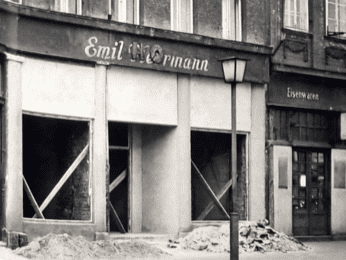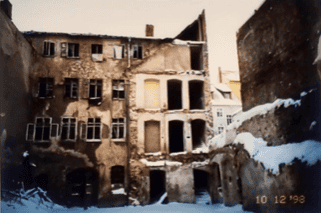


the Goerlitzer Obermarkt and the house Obermarkt 4
Unser Standort
From Neumarkt to Obermarkt – The development of
a historic square
a historic square
The Görlitz Obermarkt is, alongside the older Untermarkt, one of the two most well-known and defining squares in the Old Town of Görlitz.
In the 13th century, Görlitz extended only as far west as Brüderstraße, around the Schwibbogen and today’s tourist information office. The monastery founded in 1234, whose remaining original structure is the Church of the Holy Trinity, was still outside the city limits at that time.
Back then, Upper Lusatia was part of the Bohemian Kingdom. It was later transferred to the Brandenburg Ascanians after an unfulfilled dowry agreement. From 1254 to 1319, they ruled the region before Görlitz returned to Bohemian control until 1635, after which Upper Lusatia became part of Saxony.
The Ascanians founded a new district called Neustadt. The new square was first known as Neumarkt, and its western part, leading toward the Reichenbacher Tower (first mentioned in 1376), was called Oberneumarkt. From 1717 onward, the entire area became known as Obermarkt.
The city began expanding its fortifications in 1255 and was officially granted town rights in 1303.
Obermarkt as a trading hub along the Via Regia
The square was originally a grain market. Traders entered from the Neisse Bridge via Neißstraße and Brüderstraße, offering their goods in open sacks. Products from the surrounding region were also sold here.
Obermarkt was located on the Via Regia, a major trade route stretching from Kyiv and Kraków to northern Spain. Görlitz was also intersected by a north-south route running from the Baltic Sea through Frankfurt (Oder) to Prague.
Around 1407, a “Salzhaus” (Salt House) was built in the central part of the Obermarkt, serving as both market and dance hall. It was torn down in 1851.
Destruction and rebirth
Görlitz suffered heavily during the Thirty Years’ War, with the city being plundered several times and many buildings on the Obermarkt burning down.
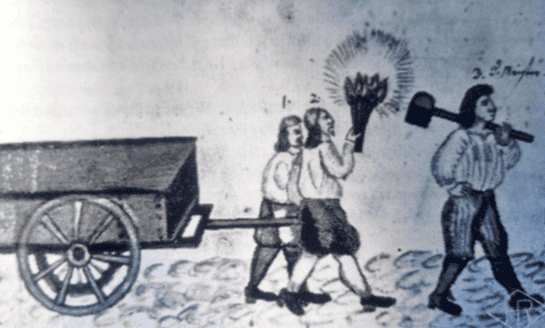
Major city fires were also recorded in the years 1131 (possibly the entire city burned), 1456, 1479, 1506, 1525, 1530, 1537, 1557, 1633, 1641, 1642, 1691, 1717, 1726, 1750, 1759, 1807, 1808, 1813, and 1817.
The fire of 1717 was especially devastating and destroyed most of the houses on the northern side of the Obermarkt, which were later rebuilt in the Baroque style. The southern side remained mostly intact, and buildings such as Obermarkt 3, 5, and 6 retained Renaissance façades until around 1800.
Obermarkt 4 was among the houses burned in 1633 and was rebuilt in 1634. In 1722, it received a Baroque façade, likely as part of modifications that included the addition of a fire gable.
During the Seven Years’ War, the square saw troop movements and tax burdens. In 1745 and 1757, Frederick the Great stayed in Obermarkt 31, and King Frederick Augustus II of Saxony stayed in house no. 29. From that balcony, Napoleon later addressed his troops before the Battle of Bautzen.
Obermarkt between monuments, dictatorship, and democracy
After 1871, the square took on the style of the Gründerzeit era. The last remaining old houses were demolished and replaced with new ones. Shops with large glass windows appeared on the ground floors.
In 1893, an equestrian statue of Emperor Wilhelm I was erected where the Salzhaus once stood. The tram ran along the southern edge of the square, and the Obermarkt became a popular venue for parades and military concerts.
In the 1930s, the square reflected the political climate. Between 1933 and 1938, Jewish business owners were forced to sell their properties at below-market prices. A visible trace from that period is the 1936 redesign of the façade at Obermarkt 15, which remains a historic architectural witness.
In 1939, the square was completely redesigned to accommodate parades. The equestrian statue was moved to Wilhelmplatz, the tramline was closed, and the paving and walkways were updated to their current layout.
Görlitz was largely spared from wartime destruction, but several buildings on the Obermarkt were damaged or destroyed, including no. 24, 30, and 31.
During the GDR period, the Obermarkt was renamed Leninplatz. Houses no. 30 and 31 were rebuilt. The square was the site of major protests during the East German uprising on June 17, 1953, with tens of thousands gathering there.
It was also used as a parking lot, a decision from GDR times to accommodate increasing car ownership – a feature that still shapes the square today.
During the reunification period, Helmut Kohl visited Görlitz on September 27, 1990. Around 25,000 residents gathered to hear him speak on the Obermarkt.
Today, the square is used for major events such as the Altstadtfest and the Christmas market ice rink.
And what about the house at Obermarkt 4?
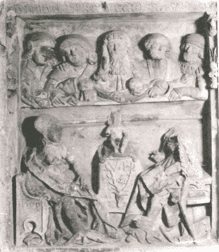
Sippenrelief des Valentin Hirschmann 1513
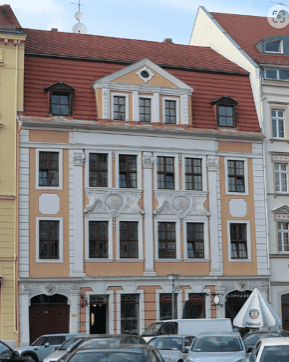
Obermarkt 24
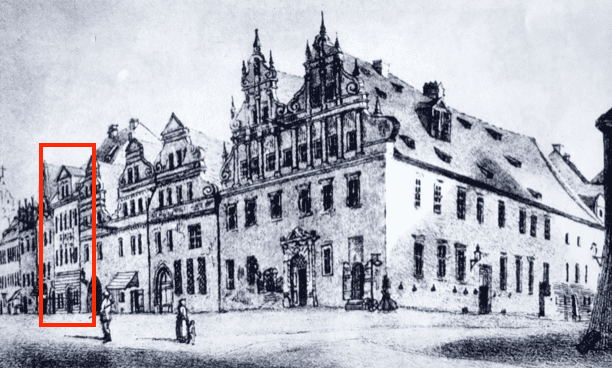
Das Haus Obermarkt 4 (outlined in red) in a sepia drawing by Chr. Nathe from 1800. You can see the Baroque façade, the adjoining double houses Obermarkt 3 and 5, as well as house no. 6, still with its Renaissance façade.
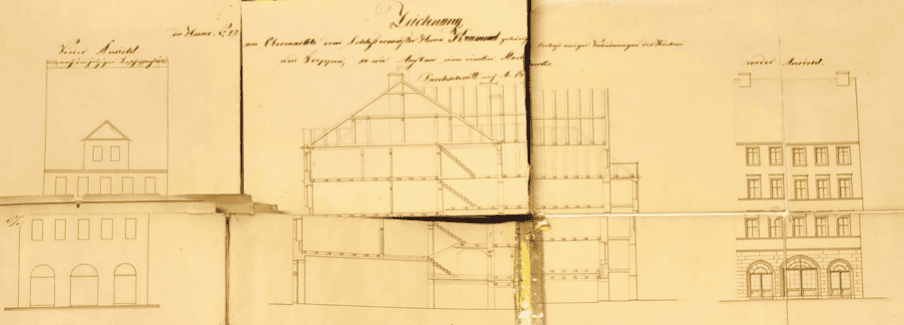
remodeling plan 1847
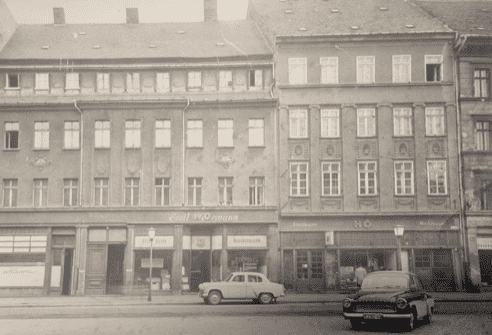
Obermarkt 3 and 4 in the 1960s and 1970s, photos from the building records.
The southern rear building in 1998, photos from the building records.